
The UAE protects dugong habitats
The UAE protects dugong habitats
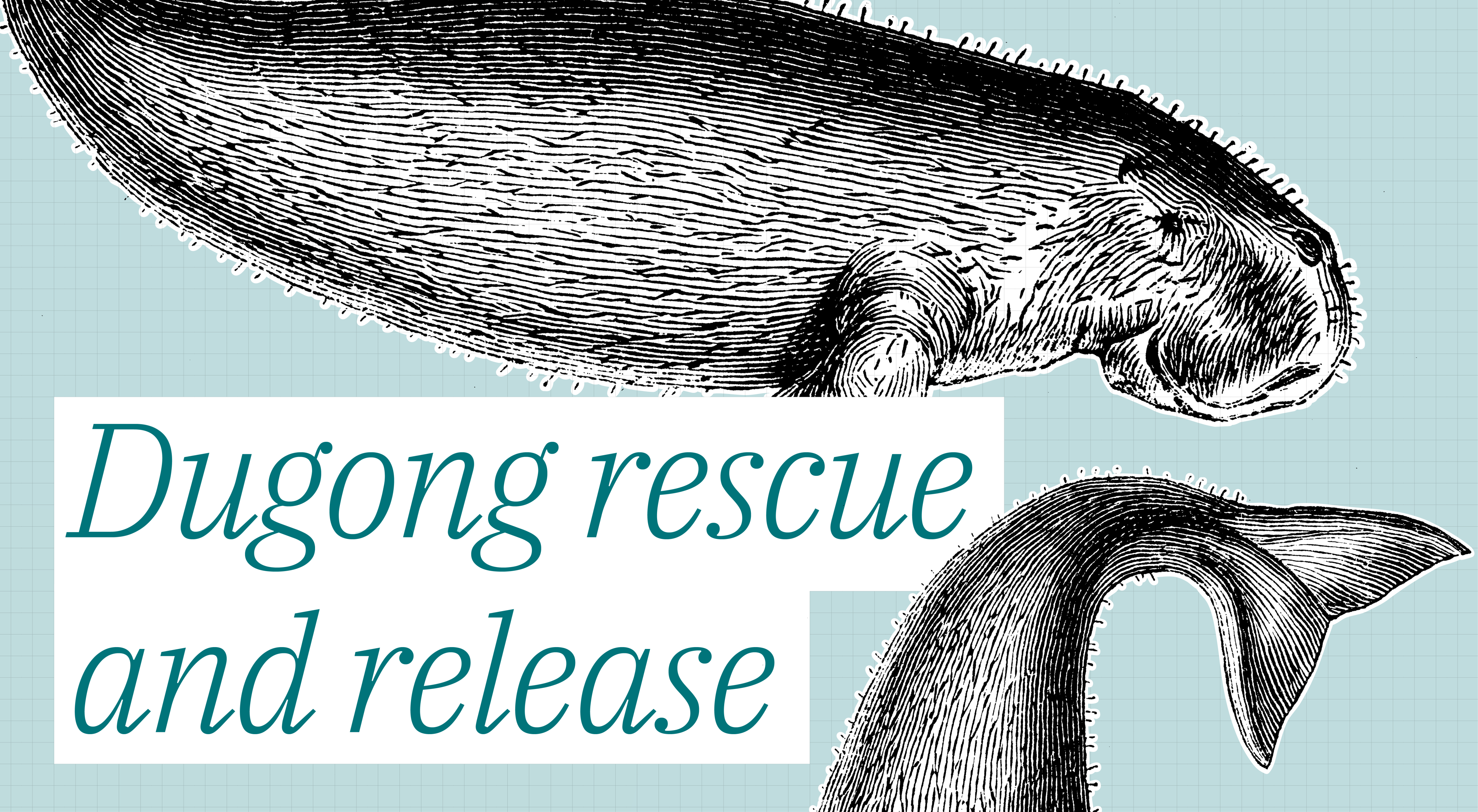
The unsung heroes of marine ecosystems, dugongs are now threatened across much of their range. IUCN Members and partners are leading global efforts to protect these mysterious creatures of the ocean floor
By Joe Shute
Dr Balaji Vedharajan, founder of IUCN Member, OMCAR Foundation (‘OMCAR’), has spent a lifetime extolling the wonders of the seagrass meadows of Palk Bay, and the mysterious dugongs (Dugong dugon) that reside there. As a teenager growing up in the southern India state of Tamil Nadu, he constructed an underwater camera to show his family photographs of the hulking mammals, also known as ‘sea cows’, that graze the shallow coastal waters. Several decades later and Dr Vedharajan still devotes himself to advocating for the waters and wildlife of Palk Bay – only now he is telling the world.
Last year at the IUCN World Conservation Congress in Abu Dhabi, Members adopted resolution 025 requesting recognition for India’s first dugong conservation reserve, which has been established in Palk Bay for the protection of a species that is listed as Vulnerable on The IUCN Red List of Threatened SpeciesTM.
OMCAR was the proponent of the resolution, which was co-sponsored by Members from India, Japan and Switzerland*.
“The recognition we received is very important and encouraging for our work,” says Dr Vedharajan. “Now the global community knows about the importance of the dugongs and seagrass meadows of Palk Bay.”
Vital ecosystem engineers
The fate of the dugongs in Palk Bay is indicative of the global decline of these large marine mammals, which can grow up to 3m in length and weigh half a tonne. Despite this vast bulk, dugongs have a strictly herbivorous diet and graze expansive seagrass meadows where they can eat up to 60kg of vegetation a day.
Their notoriously messy grazing style means that they are considered vital ecosystem engineers, as they promote vigorous regrowth of seagrass meadows, which are one of the world’s most important barriers against climate change – storing carbon around 35 times faster than tropical rainforests.
Palk Bay is India's first dedicated reserve for dugongs
Palk Bay is India's first dedicated reserve for dugongs
The rich coastal waters of Palk Bay between India and Sri Lanka, which contains more than 12,250 hectares of seagrass meadows in its northern regions alone, once provided a stronghold for dugongs, whose range spans the waters of some 40 countries across the Indo-Pacific.
While traditionally hunted by the small fishing communities along the coastline, Dr Vedharajan says the arrival of large trawlers in the 1970s and 1980s rapidly hastened their decline. Today, there are thought to be no more than 300 individuals left.
Community-led conservation
Despite this perilous situation, he insists that he holds on to hope. OMCAR has established a network of 65 schools, which attend awareness-raising events. By situating its headquarters in a community centre, OMCAR has also helped with food and disaster relief during the cyclones which periodically strike the area.
During the Covid lockdowns, OMCAR donated rice to coastal communities. This outreach work may sound a long way apart from marine conservation, but it has helped create a powerful network among local fishing communities who, Dr Vedharajan says, inform them about any dugong sightings and seek to avoid catching them in their nets, and also help rescue and release them.
Local fishers in Palk Bay are now helping to rescue and release dugongs
Local fishers in Palk Bay are now helping to rescue and release dugongs
Given that the threats to dugongs are almost entirely caused by human activity, with fishing and particularly the use of gill nets (which hang vertically towards the ocean bed) posing the gravest danger of all, these connections can play a significant role.
I see dugongs as a powerful tool for governments to be able to come together in peace around a common cause
Dr Balaji Vedharajan
Cross-border ties
The establishment of India’s first dugong reserve in 2022 is accelerating efforts across Palk Bay. The foundation stone was recently laid for a new centre hosting both visitors and researchers interested in dugong conservation. At the same time, Dr Vedharajan has approached colleagues within IUCN to help establish cross-border ties in Sri Lanka, a significant step in an area which until 2009 was the scene of a long-standing conflict involving the two countries.
“I see dugongs as a powerful tool for governments to be able to come together in peace around a common cause,” he says.
The plight of dugongs globally was a key area of discussion at last year’s IUCN World Conservation Congress, where the official launch of the A Global Assessment of Dugong Status and Conservation Needs report also took place. Professor Helene Marsh, lead author of the report and Co-Chair of the IUCN SSC Sirenia Specialist Group (the genus to which dugongs belong), says the report highlights the significant mix in dugong fortunes across its range. In Australia, where Professor Marsh is based at James Cook University, for example, there are thought to be in the region of 166,000 dugongs grazing the expansive seagrass beds.
However, the report, to which 70 scientists contributed including Dr Vedharajan, found that there are numerous smaller populations such as in East Africa, East Asia and isolated islands where the dugong is at risk of being extirpated altogether.
“The biggest risk to the dugong is a major reduction in its range rather than extinction per se,” says Professor Marsh. Of particular concern, is the lack of genetic variation in these smaller populations of dugongs limiting their ability to adapt to an ever warming ocean.
Reliant on seagrass
Key to the success, indeed survival, of dugongs are thriving seagrass meadows. The report urgently recommends the need to map and protect dugong habitat as part of the 2030 Seagrass Breakthrough, an international framework to safeguard more than 16 million hectares across the world’s ocean and accelerate restoration. “One of the big messages of the report is the inadequacy of seagrass mapping in the dugong range and actually across the tropics,” explains Professor Marsh.
There is an ominous warning in history over the fate of the dugong, in the shape of the Steller’s sea cow, which was hunted to extinction in the late 1700s. The dugong remains its closest living relative and the only surviving member of their mammalian family. “If you think of the tree of life, losing an entire mammalian family is not just a leaf, but like chopping off a pretty big limb,” warns Professor Marsh.
Today dugongs face a myriad of threats. Beyond the constant peril of fishing boats, vessel strikes, noise and plastic pollution, and coastal development remain key issues, alongside increasingly severe storms being whipped up by climate change, which can devastate their feeding grounds and leave calves stranded. Because they are an exceptionally long-lived creature, with roughly the same lifespan as a human and a slow breeding rate, dugongs are particularly susceptible to reductions in population.
Monitoring with AI
Nonetheless, there are several success stories in the modern era. In Abu Dhabi, UAE (IUCN State Member), AI-powered aerial drones and autonomous underwater vehicles are being used to map the seagrass beds.
“In Abu Dhabi, we identify critical ecosystems, such as seagrass beds that support dugongs and sea turtles, and ensure they are conserved through protected areas, strict zoning and the enforcement of environmental laws,” says Dr Shaikha Salem Al Dhaheri, Secretary General of the Environment Agency Abu Dhabi (EAD).
An aerial survey conducted in 2024 estimated a dugong population at more than 3,500 individuals, with mothers and calves comprising 20% of sightings.
With the Arabian Gulf being the hottest sea in the world, Dr Al Dhaheri says long-term monitoring helps detect early signs of marine heatwaves, while a ban on destructive fishing practices has also improved the resilience of the seagrass ecosystems. “In a rapidly warming sea, ecosystem-based management – grounded in science and sustained over decades – is our strongest defence in protecting both dugongs and the habitats they depend upon.”
The work of the EAD extends beyond national borders. Abu Dhabi is home to the Secretariat of the Memorandum of Understanding on the Conservation and Management of Dugongs and their Habitats throughout their Range – a specialised agreement established under the Convention on Migratory Species (CMS) – of which IUCN is a key partner. And the EAD works closely with range states to strengthen cooperation.
Raising awareness in East Africa
The Important Marine Mammal Areas, an initiative pioneered by IUCN and partners to identify key habitats across the globe to prioritise for conservation, can also play an important role in protecting dugong habitat.
One such area is Mozambique’s Bazaruto Archipelago National Park, home to what is now considered the last remaining viable dugong population along the eastern coast of Africa. Here fishing remains a critical part of the local economy. However, the use of seine nets (which are dragged through the water), rather than gill nets, has dramatically decreased the risk to dugongs as they are continually monitored and their design poses far less of a threat.
African Parks, which runs the national park, with the Mozambique national government, has been working closely with local communities to raise awareness of the importance of dugongs and their value to the area through tourism. Evan Trotzuk, African Parks Research and Monitoring Coordinator for the Bazaruto Archipelago, says each year roughly 20% of the national park’s income goes back into communities, funding initiatives such as access to clean water and new medical clinics.
Since African Parks started working in the area in 2017, he says, not a single unnatural dugong fatality has been recorded within the national park boundaries. Meanwhile anecdotally, dugongs are now appearing in places where they have not previously been sighted for a long time.
In 2022, the IUCN Red List categorised the entire dugong population of East Africa as Critically Endangered, something which Trotzuk says has particularly helped in raising awareness of its plight across the continent.
But the green shoots of recovery in the Bazaruto Archipelago demonstrate an alternative future in which humans and these giants of the ocean can peacefully co-exist.
*Proponents and co-sponsors of Resolution 025: OMCAR Foundation (India); Aaranyak (India); The Corbett Foundation (India); Wild Bird Society of Japan (Japan); Centre for Environment Communication (India); Nature, Environment and Wildlife Society (India), Gujarat Institute of Desert Ecology (India), Gallifrey Foundation (Switzerland).
For more information, see WCC-2025-Res-025: Recognising India’s first dugong reserve
See the report on A Global Assessment of Dugong Status and Conservation Needs
IUCN Membership
Learn about the benefits of joining IUCN as a Member
IUCN Commission
Learn about the benefits of becoming an IUCN Commission Member
Credits
Video: OMCAR Foundation; Photos: Ivanenko Vladimir/Shutterstock; Cinoby, Frank Ramspott, Ilbusca/Digital Vision Vectors/Getty Images; Doug Perrine/Seapics.com; Mia Stawinski
 Built with Shorthand